

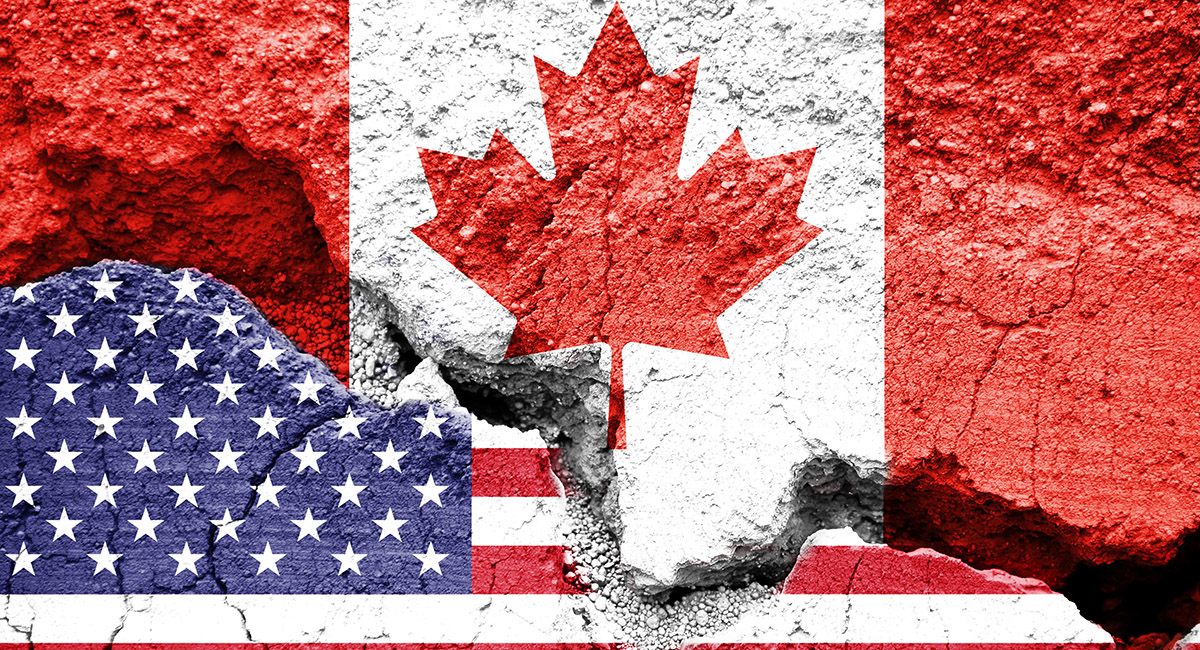
In retaliation for Canada’s counter-tariffs, the Trump administration has announced it will impose 50 per cent duties on additional Canadian products starting Sept. 15.
The move comes on top of a ban on certain Canadian imports, effective Sept. 29, that includes most alcoholic drinks, some dairy products and motorcycles. It follows U.S. tariffs introduced after trade talks between the two countries broke down in August.
If implemented, the new levies will add to the pressure on businesses already affected by the trade dispute, while also hitting other companies and consumers, although the Canadian flooring industry appears to be outside the scope of the new duties.
Canada’s Counter Tariffs
On Sept. 8, Canada imposed 15, 25 and 50 per cent tariffs on $27.6 billion of imports from the U.S., with individual product rates based on the corresponding U.S. rate for the same goods. The measures target sectors that are most affected by U.S. duties.
Flooring industry products affected include carpets and other textile floor coverings, which face a 25 per cent tariff, and vinyl flooring, which faces a 50 per cent tariff.
Several other categories relevant to the Canadian flooring industry and their tariff rate include:
- Plywood/veneered/laminated panels: 50 per cent
- Selected softwood lumber: 25 per cent
- Wood screws: 50 per cent
U.S. Tariff Escalation
The new U.S. tariffs on a range of exports, including items that fully comply with the Canada-United States-Mexico Agreement, have broadened the trade pressures facing Canadian businesses. Among those affected, more than three-quarters expect their revenues to drop, according to the Canadian Federation of Independent Business (CFIB). One in three expect revenues to fall by at least 50 per cent.
While the tariffs introduced in August, through three executive orders, primarily target motor vehicles, dairy and alcohol, they also apply to products outside those categories. Tariffs affecting the flooring sector include those on mouldings and profiled wood, fibreboard and plywood, among other items.
Housing Market Hurt
Erin Ruddy, editor of Canadian Apartment magazine, reports that the tariff war threatens to throw the timelines and costs of housing projects in Canada into disarray. Developers already grappling with labour shortages, high interest rates and soaring land costs now face a destabilizing force that could impact every aspect of the construction process. Estimates had put the tariff driven cost load on new Ontario homes at $15,000 to $25,000 per unit. With Canada’s counter tariffs, adding costs on appliances, electronics, pulp and paper, among other products, that number will be pushed even higher.
Future Uncertainty
Tyler Holt, editor of Wood Industry magazine, which focuses on the business side of woodworking, says the next major U.S. development could come after Oct. 1, when the commerce secretary is required to report to the president on hardwood timber and lumber imports, market conditions and the domestic industry. The deadline does not automatically trigger a tariff. However, the review could lead to additional Sec. 232 duties on hardwood timber and lumber.
For secondary wood manufacturers, Holts says the greater concern may be the explicit possibility of tariffs on hardwood “derivative products.” Depending on how broadly that term is ultimately defined, future measures could extend to additional furniture products.