

The Lowdown on Multi-head Sanders for Hardwood
By Wayne Lee
It’s best to start backward and move to where we are now. Drum sanders became belt sanders, scrapers became palm sanders, dust control became the standard and hard-plates became multi-disc sanders.
The first multi-disc unit I saw was the Trio from Lägler in 1994. The tool was not created to replace the big machine, but to reduce stress on the body, remove imperfections and minimize the scratch. The driving force of the Trio was to flatten the floor and complement the big machine. Today, there are multiple options for multi-disc sanders or, as I like to call these tools, paper turners. The paper does the work and it’s the mineral that cuts.
Unforgettable Features
Multi-disc sanders may use paper sizes from four to eight inches. Even though the units are all unique and different in their own way, each offers the same feature with regards to getting imperfections like chatter, wave and dish-out out of the floor. Hard plates can do this as well, but unlike today’s multi-disc units, they can leave a harsher scratch. I see this as the best feature of the multi-disc. It can get a floor flat while reducing its own scratch at the same time.
The next feature of multi-disc sanders is how they complement the big machine. Yes, I see social media posts of folks doing the total job with just the multi-disc and a jitter-bug (also known as a palm sander), but when you have a remodel job with some bad overwood or loose floors, it can take more time to get the floor flat.
One or two cuts with the big machine on angles will speed up the job. It is not uncommon to cut a floor on a 15 to 20 degree with 40 or 50 grit (big machine) to get it flat, then jump to 60 grit (multi-disc) to remove the angle cut using a multi-disc sander.
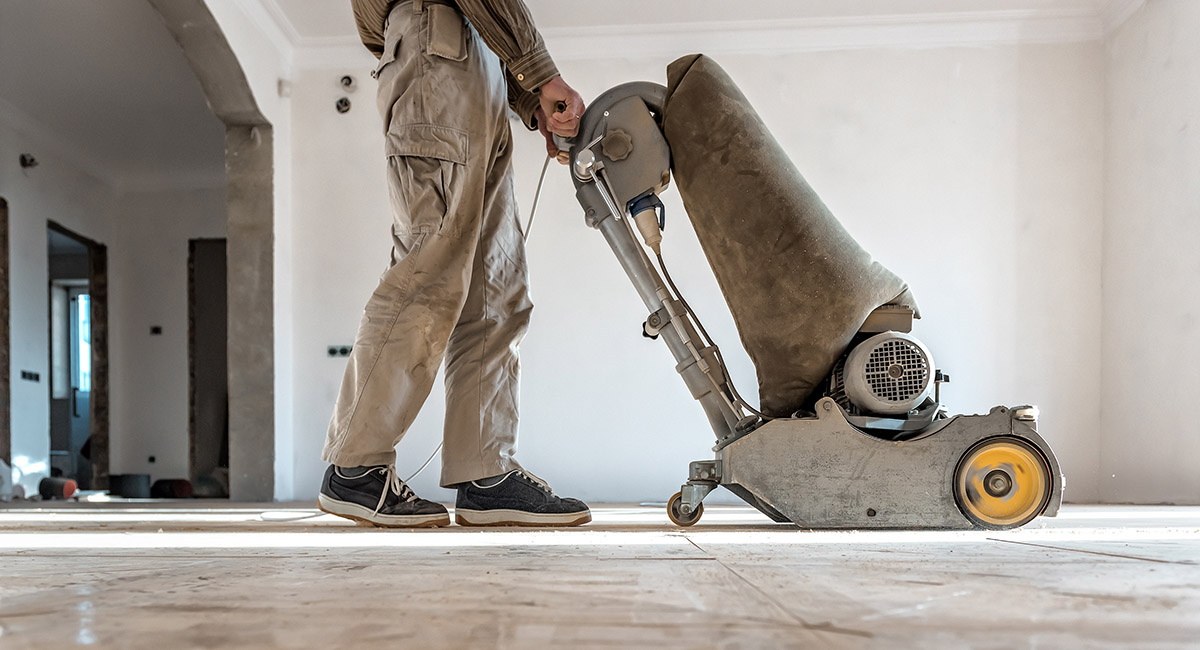
The next best feature is you can put the untrained floor mechanic behind the unit. Pushing it like a shopping buggy cannot get any easier for the newest crew member.
Let there be light directed at the floor. This feature offers light with a purpose. Seeing the fine scratch can be a challenge at times, so having scratches exposed with bright LED lights is a must.
Having choices with power is great as well. In some older homes, there are still screw-in fuses and getting 220-volt is a battle. The 115/120-volt units give people an option when dropping a 220-volt line is otherwise impossible. (The 115/120-volt units do require a ‘clean’ line to prevent popping breakers or fuses.) These units are not as heavy and one person can tote them in and out of the home. They cut flat, scratch less and floors look amazing once finished.
Big Benefits
The most important benefit of using multi-disc units is the final flat, scratch-free look of the floor. Zero wave, zero chatter, zero dish-out, zero drum marks, refined scratch — the perfect surface that lets the finish lay right on the floor like it was meant to be. Multi-direction floors, mixed species, flat sawn floors, wide boards, floating floors, engineered flooring and custom installs fall right into the benefits of when and where to use multi-disc machines. The multi-disc units can also be used on factory finished floors.
With diamond drivers, you are able to cut through the finish quickly while saving money on high-performance sandpaper. Once the finish is cut off, you can move forward with the big machine to remove any micro-bevel or overwood. Again, the multi-disc is complementing the big machine while saving time, money and body fatigue.
Minimize Scratch
Every machine has a cutting point and footprint. While it seems like it would not matter how you travel across the flooring with these units, that is far from true. The multi-disc units that work like the buffer still move right to left and up and down with handles. The multi-disc units you can move around like a shopping buggy have slight slope. The main heads rotate opposite the disc on almost all units. There are a few that rotate in the same direction as the main head and that can change the way the unit cuts. The most important factor is they all drive paper and that paper will leave a footprint.
First, the size of the paper matters. Four-inch paper almost always is not round but has a flower shape. This helps with the cleanup of its own scratch. If it hits a void and then hits the void again, it helps to reduce its own scratch much like inter-coat pads and sandpaper. It cuts, cleans, cuts and cleans while you are using the cutting point on the machine.
The friction drive units have a two-degree pitch to the drive disc. The main head spins counterclockwise, making the drivers spin clockwise. Units like this have more pressure on the outer edge of the pads. They flex a small bit and are aggressive. They flatten fast with a smaller footprint. Some units have six discs while others have five. The five-disc unit will cut faster and flatter than the six-disc unit. The scratch is easy to hide when using the correct grit sequence with either of these types of units.
Most people water pop so the ‘angel hair scratch’ hides when stain hits the floor. The seven and eight-inch units cut flat and are planetary driven with a belt, gears or chain, and can be bigger and heavier. The extra weight and size does change the footprint to a much wider base and cut. They do leave a longer scratch due to the size of the paper. Get down on the floor with a bright LED beam and look at how each unit cuts, cleans and leaves a scratch.
Manufacturers’ representatives will all tell you that theirs is the best, fastest and hides the scratch. Ask me and it’s all about your style, needs and how they can complement your sanding jobs.
This affects me when I see the last coat of finish. The flat floors look amazing. I do not have to spend more time reducing the scratch. The reduction of stress on the body is huge and having the ability to control the speed on the unit aids with the paper’s life. Training a new floor mechanic is easy and fast. It brings all of us up to the next level.
Wayne Lee is business development and technical advisor for Middle TN Lumber in Burns, Tenn. He can be reached at [email protected]. This article is an abridged version of the one that first appeared in the April/May 2025 edition of Hardwood Floors, the magazine of the National Wood Flooring Association.