

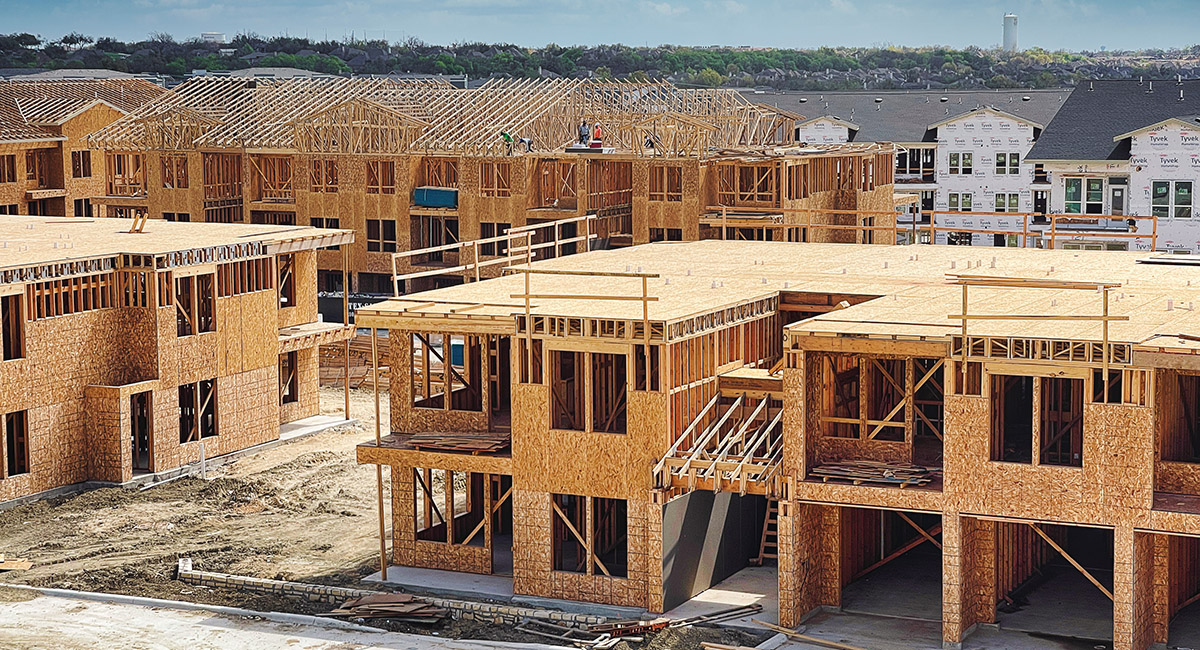
Canadian housing starts climbed again in the third quarter but record low builder sentiment, layoffs and a sharp pivot toward rentals point to a fragile pipeline for ownership housing.
National Picture
In population centres of 10,000 or more, actual housing starts in Q3 totalled 57,215 units, up from 51,351 a year earlier — an increase of roughly 11 per cent.
Month by month, the quarter was consistently stronger than last year, with gains building as the quarter went on: modest in July (up four per cent), more pronounced in August (up nine per cent), and significant in September (up 22 per cent).
By dwelling type, Q3 starts were again heavily skewed toward multi-family construction. Nationally, single and semi-detached groundbreakings rose to 15,860 from 15,113 year-over-year, an increase of about five per cent. Multi-family starts climbed to 54,026 from 47,023, a gain of roughly 15 per cent.
Completions told a slightly different story. Single and semi-detached completions edged down a meagre 0.6 per cent, while multi-family completions rose nearly five per cent. This points to a pipeline that remains tilted toward apartments: work is still flowing steadily through to the finishing stages even as future sales become more uncertain.
Provincial Trends
Third quarter housing starts in British Columbia were up 12 per cent year-over-year to 11,129 from 9,965. The provincial totals, however, hide a dramatic split between Lower Mainland/Island markets and the interior, where growth is highest in regions like Kamloops (+100 per cent) and Chilliwack (+104 per cent). Kelowna, however, saw housing starts drop a whopping 67 per cent, marking one of the sharpest declines in the country and a continuation of the correction already evident in earlier quarters.
Across the Prairies, Alberta remained the standout with the most starts (12,812), but Manitoba saw the greatest increase (+21 per cent). Alberta’s housing strength sits on top of an economy still benefitting from unrestricted energy exports to the United States, even as other sectors face tariff headwinds. That said, survey data show builder sentiment in the Prairies easing off earlier highs, particularly for large multi-family projects.
Ontario remained Canada’s problem child. The single most-developed province with Canada’s largest metropolitan area is continuing to see contraction as a result of high construction costs and high home costs at completion. Provincial starts slipped five per cent to 18,743 from 19,757, the only large province to post a decline. The city-level picture is mixed with large gains in Kitchener-Cambridge-Waterloo (+223 per cent) and Brantford (+198 per cent), and big losses in Kingston (–63 per cent), Peterborough (-55 per cent) and Guelph (–52 per cent). Toronto saw housing starts decline nearly 20 per cent to 7,554 from 9,419.
Quebec, by contrast, has moved into a quiet leadership role. Q3 starts grew 24 per cent to 11,927 from 9,610. Much of the provincial growth is concentrated in Montreal (+113 per cent) and selected rental-heavy projects, supported by provincially aligned financing tools and, in some cases, more predictable approval processes than builders face in Ontario or B.C.
In Atlantic Canada, the headline was Nova Scotia. Provincial starts more than doubled to 2,598 from 1,226, driven by Halifax (+165 per cent). Elsewhere in the region, key cities showed a mix of pullbacks and gains, but the overall Atlantic picture was one of elevated activity compared with a year ago.
Sentiment and Sales
Against that reasonably healthy construction backdrop, confidence has rarely looked worse. The Canadian Home Builders’ Association’s housing market index (HMI) fell to 23.3 for single-family builders in Q3, a new record low and down 4.1 points from a year ago. The multi-family HMI dropped to 16.8, also a record low and the first time either index has fallen below 20.
Roughly 59 per cent of single-family builders now rate current selling conditions as poor, and only eight per cent expect good conditions over the next six months. About 70 per cent report low or very low sales office traffic. That pessimism is even more acute in the condominium and stacked townhome segment: 68 per cent of multi-family respondents describe current selling conditions as poor and 61 per cent expect them to remain poor. Canada Mortgage and Housing Corporation reports that 13 per cent of Canadians are currently working toward the purchase of their first home, but almost no respondents expressed any certainty in their ability to buy within a year from now.
Regionally, Ontario and British Columbia are where sentiment is most fragile. Ontario’s single-family HMI is just 7.1, with multi-family at 4.4, and 64 per cent of builders in the province report permanent layoffs. British Columbia’s multi-family HMI has also fallen sharply from a year ago, reflecting tougher conditions in key urban condo markets.
Nationally, 41 per cent of builders say they or their subcontractors have had to lay off workers with no plans to rehire — up from 27 per cent a year ago and 35 per cent last quarter. Residential payrolls have posted their largest 12-month decline since 2009 (outside the pandemic). For suppliers, that’s a warning: Fewer active sales teams and fewer staff on sites today imply fewer new project decisions six to 12 months from now.
Policy Delays, Tariffs and the Pivot to Rental
Weak sentiment is being reinforced by policy uncertainty and cost pressures.
Builders continue to point to the unimplemented GST rebate for first-time buyers as a direct drag on sales. The measure has been announced but not yet brought into effect, leaving buyers unsure about their net purchase costs. Many builders report this uncertainty weighed on summer traffic, particularly for entry-level projects where a rebate could make or break affordability.
Tariffs remain a second major concern. While some counter-measures have been removed, many builders say tariffs on key metal components — doors, window casings, sinks, furnaces — are still feeding cost inflation. The broader tariff regime has hit Ontario especially hard: steel and auto tariffs undermine employment in the province’s industrial heartland, dampening job security and appetite for big-ticket purchases like new homes.
At the same time, the federal Build Canada Homes initiative is releasing more public land and leaning heavily on incentives for modular construction, while Ontario’s Bill 17, Protect Ontario by Building Faster and Smarter Act, delays development charges until occupancy and seeks to standardize codes. These measures should improve project economics over time, but for now they sit alongside unresolved cost and demand issues.
A crucial shift for this audience is the pivot from ownership to rental. Through the first three quarters, urban starts intended for freehold or condominium ownership numbered fewer than last year, while purpose-built rental starts were significantly higher. Survey data show that nearly 40 per cent of builders have either moved or are considering moving into rental development. This means more large-scale multi-unit projects and fewer highly customized ownership homes, especially in Ontario.
Interest Rates, Costs and Project Economics
The interest rate environment has turned more supportive than it was at the peak of the tightening cycle. Policy rates are lower and that relief is filtering into mortgage costs and construction financing. That backdrop has helped keep quarterly starts elevated despite weak sentiment.
However, lower rates alone are not enough to offset other pressures cited by builders: high land prices and municipal fees; tariffs and supply chain premiums on non-lumber materials; and labour costs and chronic skilled trades shortages.
Industry estimates suggest that non-lumber materials now add roughly $72,000 to the cost of a typical 2,400-square-foot home compared with 2020; including lumber, the additional materials cost approaches $99,000. With wages and financing also more expensive than pre-pandemic norms, a growing number of projects, particularly condo towers in Toronto and parts of B.C., no longer pencil out without additional policy relief or deep price concessions.
Tyler Holt is the editor of Wood Industry magazine. He has a master’s degree in literature and publication, and years of experience in the publishing and digital media industry. His main area of study is the effect of digital technologies on industrial and networked production.