

Navigating PSAs and their Application in LVT Installs
By Jeffrey B. Johnson
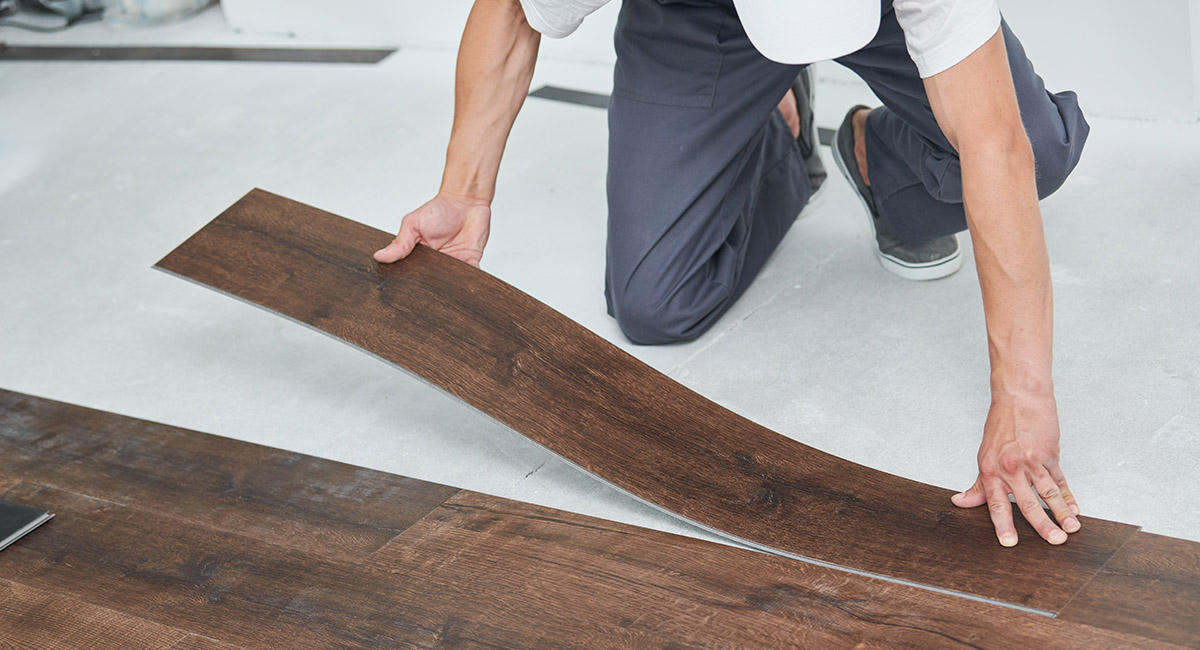
If you’re in the floor covering business, whether a manufacturer, retailer, dealer or contractor, you’ve probably heard about the many benefits of luxury vinyl tile (LVT). The growth of this flooring category continues to amaze industry analysts, with its continued acceptance in virtually all types of commercial and residential applications. One of the biggest drivers of this growth is undoubtedly the many visual options available, coupled with the modular nature of the flooring material. LVT comes nicely boxed on a pallet, making it easy to receive and move in a building. Once it has been dispersed on a job site, it’s a relatively simple ‘click the LEGOs together’ type of installation.
A lot of the excitement around LVT is based on an unsung hero — the pressure-sensitive adhesive (PSA) used to bond LVT to the substrate. Many LVT adhesives have been introduced over the years, and manufacturers of these products are inventing new, improved versions almost monthly. With so many brands, products and types available, the challenge flooring contractors face is choosing the right one for any given installation condition.
In the beginning (and I will go way back in time here), LVT or vinyl-enhanced tile was installed with wet-lay, hard-set acrylic adhesive, which required a porous substrate that was very dry. This was necessary because wet adhesive was being trapped under an impervious material (LVT); for the adhesive to dry, it needed a dry and absorptive substrate. These installations went well but often required moisture mitigation, self-levelling installation and a lot of time to install the flooring into a wet adhesive.
It is important to note adhesives designed for the installation of LVT must be plasticizer migration-resistant, which means formulations based on styrene-butadiene rubber (SBR) and hydrocarbon resin blends (typically used for vinyl composition tile and broadloom carpet) cannot be used. LVT is plasticized using phthalates or other chemicals to make the tile flexible and installable. SBR adhesive bases do not stand up to plasticizers. Because of this, acrylic adhesives, which are plasticizer-resistant, are the best solution.
Returning to the installation process, using a wet-lay adhesive on dry concrete substrate became a huge issue for the fast-paced, high-pressure, ‘get it done now’ world of floor covering installation. Installing into wet adhesive with limited working time was one thing. Getting a dry subfloor was completely another. Enter the hero of the story: acrylic PSA.
Adhesive manufacturers began creating PSAs at higher moisture limits for concrete subfloors, thereby allowing flooring contractors to install on newer slabs a lot faster without the need for moisture mitigation and levelling. The trend started out at eight pounds (3.63 kilograms) in moisture vapour emission rate (MVER) per ASTM F1869, and 85 to 90 per cent in relative humidity (RH) per ASTM F2170. Now, virtually everyone has a PSA for LVT with a moisture limit of 99 per cent in RH and commonly up to 15 pounds (6.8 kilograms) in MVER. This provides a huge cost savings to flooring contractors since they don’t have to moisture-mitigate. There are also labour benefits, thanks to the ability to spread huge areas with adhesive, allowing contractors to flash until the adhesive no longer transfers to the touch and then install the flooring. What’s more, working times are extended up to six hours or more.
However, contractors often forget (or at least overlook) that LVT is a piece of plastic and, as such, is sensitive to temperature just like any other material. For example, if you install LVT on a 32 C day in an unacclimated environment, it could look great when you leave. But a week later, you could very likely get a call from the building owner who says there are gaps all over the floor. What happened is simple science. The LVT was installed warm, making it slightly larger than it would be at room temperature. The building owner took possession of the property and turned on the air conditioning to bring the temperature to 22 C. Not only did the air cool but so did the flooring. Consequently, it shrank back to its room temperature dimensions and left gaps at every butt seam across the floor.
While LVT will change dimensions with fluctuations in temperature, PSAs will move under pressure. And that pressure comes from shrinking LVT. Because PSA is not rigid, it will flow, allowing for gapping to occur. So, LVT must be acclimated and installed in the working temperature of the room to minimize any gapping.
The opposite of gapping can also occur. This is called peaking and it happens when LVT is installed at room temperature and then exposed to high heat from, for example, radiant heat systems or ultraviolet (UV) radiation from large windows. These elements will warm up the LVT, causing it to expand as well as soften most PSAs. When the LVT grows, it bumps up against the next piece, causing peaking.
Flooring manufacturers and importers of LVT are no longer supporting pressure-sensitive-type adhesives and installation methods, forcing flooring contractors to return to using a wet-lay or semi-wet-lay technique. This change in direction is a direct result of the industry trying to control LVT gapping and peaking. There is some advantage to using a PSA in a wet-lay installation method. The main advantage is greater bond and, as a result, increased shear, which does little to reduce the potential of LVT gapping or peaking. PSAs are pliable, that’s how they work. The greater the pressure, the more they press into the flooring material. Even those that are ‘transitional’ or ‘phase changing’ will exhibit some movement under shear — there is just no way around it. The main disadvantage of these new directions is that flooring contractors’ installation efficiency went out the window and they must go back to a wet-lay installation method.
The bottom line is PSAs are great at what they do if you can control the temperature of the flooring material and/or the room in which it will be installed, and if you can prevent any major swings in ambient temperature that could cause gapping or peaking. When you can’t control those factors, then you need to look at other adhesive alternatives. Going back to the old way of using a hard-set, wet-lay acrylic is an option. Using a reactive adhesive, whether it’s a two-part epoxy or a moisture-curing modified silane, will also go a long way to control gapping and peaking. These types of adhesives are highly recommended if you are installing LVT in front of a plate-glass window. The UV radiation that comes through the window will heat the LVT up 11.5 C to 17 C above the ambient room temperature, so you need to make sure the LVT is extremely well-bonded. When in doubt, reach out to the flooring or adhesive manufacturer for the best recommendation on your next LVT installation.
Jeffrey B. Johnson is the business manager for Mapei’s floor covering installation systems line. Jeffrey brings to the industry more than 35 years’ experience in the development and marketing of floor covering installation products. Practical experience in the construction industry and as a bench chemist gives Jeffrey an insightful perspective on surface preparation, moisture mitigation and floor covering installation.