

Matching Customers to the Right Wood Plank
By Marie-Joëlle Bossé
Hardwood floors bring classic appeal to any home and boast an incredibly long lifespan. One of the key decisions consumers face when selecting this type of flooring is choosing between wide and narrow plank designs. Each option offers distinct advantages and considerations.
Personal Aesthetic
Wide plank wood flooring features boards that are wider than five inches. These planks also tend to come in longer lengths because they are sourced from the trunks of larger, older trees. Their generous dimensions create a more sophisticated look often associated with custom or upscale homes.
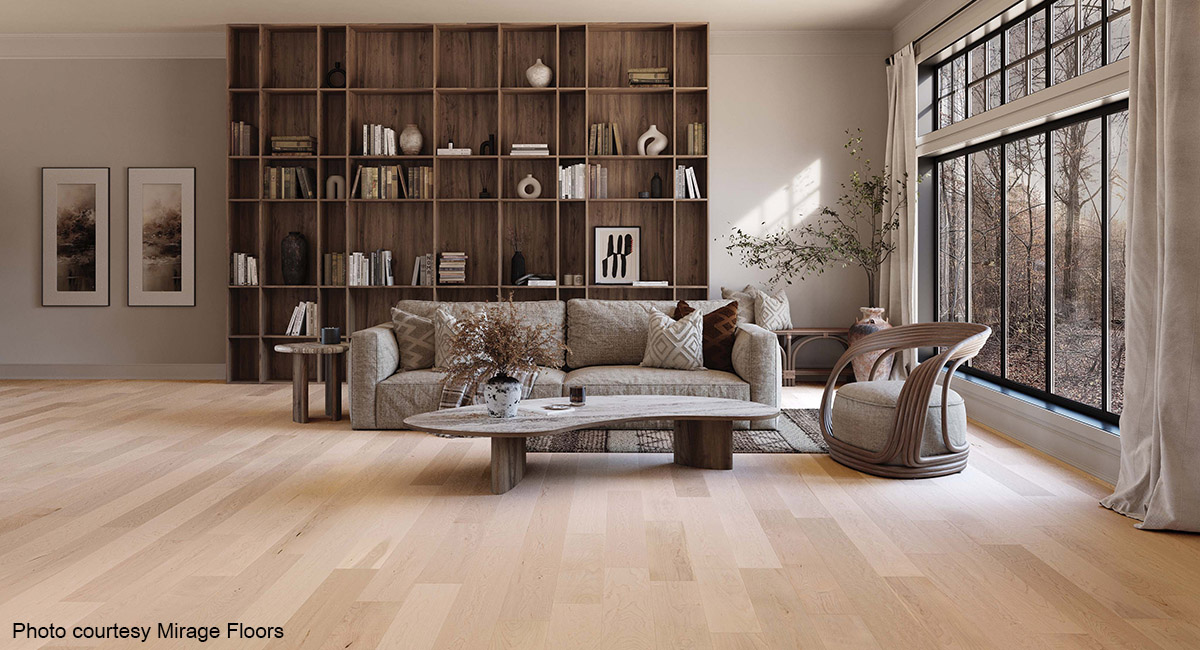
Because fewer boards are needed to cover a floor, wide planks create fewer seams, resulting in a cleaner, more cohesive look — especially in larger rooms. They can also enhance the sense of space, making open-concept layouts feel even more expansive.
Narrow plank wood flooring generally ranges from 3¼ to 4¼ inches wide, with lengths spanning from 10 to 76 inches. Five-inch-wide planks can range from 27 to 82 inches long. Because narrower planks can be cut from more parts of the tree, they offer greater flexibility in how the wood is milled.
Narrow planks lend a more traditional or transitional feel. Their smaller size creates more seams, adding texture and depth to a space. The result is a more dynamic, detailed look that can bring character and visual interest to a room.
Ease of Installation
Wide planks demand more precise installation techniques but require fewer nails or staples. Knowing how to install wide plank hardwood flooring correctly helps minimize movement and keeps the floor looking beautiful over time. Glued-assisted installation is mandatory for nailed/stapled-down and floated installations when floorboards are 7¾ inches or wider, helping to ensure greater stability.
Narrow planks are generally more stable and lightweight, offering greater installation flexibility and tending to be more forgiving. However, installing narrow planks can be more time-consuming, as a greater number of boards is needed to cover the same square footage.
Cost Analysis
Wide planks are typically more expensive due to the larger size of the material and the higher quality required to source oversized, aesthetically consistent boards.
Narrow plank flooring tends to be more budget-friendly, primarily due to the availability of materials and the efficient use of wood during manufacturing. However, labour costs may be higher because more pieces are required, increasing installation time.
Customer Selection
Selecting the right hardwood flooring size involves considering how each option complements the customer’s square footage, style and intended use.
In larger areas, wide plank wood flooring makes a strong visual impact. It brings a sense of grandeur and flow that works beautifully in open-concept kitchens, living rooms and great rooms. In a small, enclosed room with dark planks and limited natural light, wide boards might feel overwhelming. However, when paired with the right colour palette and lighting, they can actually make a space feel more open by reducing the visual clutter created by seams.
For smaller rooms, narrow plank flooring adds depth and dimension. When installed parallel to the longest wall, the planks guide the eye along the length of the room, making the space appear longer. For this reason, narrow planks are often recommended for hallways, guest rooms and offices.
Modern, farmhouse or Scandinavian design styles often benefit from the clean, streamlined look of wide planks. Homes with a more traditional layout or colonial design elements are often better complemented by narrow planks, which feel more appropriate to the style and historically accurate.
Climate Considerations
Regardless of plank size, humidity and temperature fluctuations must be taken into account to minimize moisture-related issues and ensure long-term dimensional stability. It’s not necessarily the width of the plank that determines its sensitivity to environmental changes, but rather the construction technology behind it. Wide planks, often available in a three-layer engineered format, offer excellent stability and resistance to gapping or cupping when properly selected and installed for the environment.
Similarly, narrower planks, such as those between 3¼ and 4¼ wide, are typically made from solid hardwood and perform best in environments with stable humidity levels between 35 and 55 per cent. This makes them less suitable for areas like basements, spaces near fireplaces or installations over radiant heat.
In contrast, five-inch planks are often available in engineered construction, providing greater flexibility and making them suitable for a wider variety of settings.
Marie-Joëlle Bossé is the brand and product manager at Mirage Floors, a premier North American brand of high-end prefinished hardwood flooring manufactured by Mirage in Quebec. Established in 1989, Mirage is widely recognized for superior quality, precise milling and environmentally responsible manufacturing.