

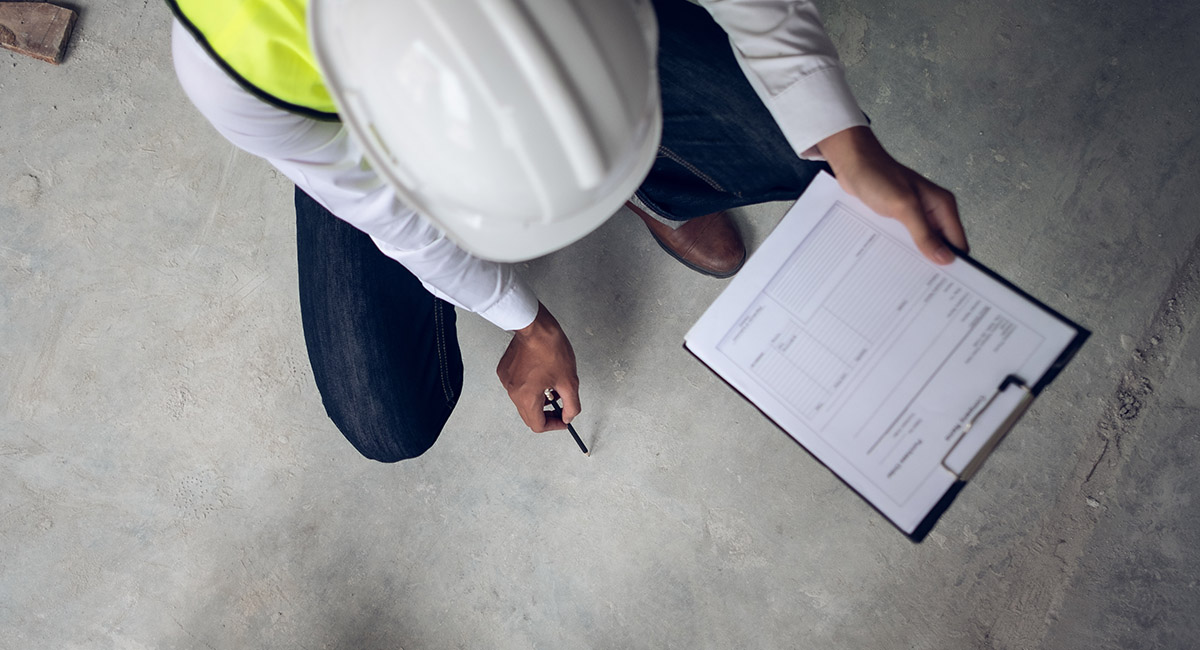
Four Methods to Test for Moisture in Concrete Slabs
By Lee Senter
Before installing floors over a concrete slab, it is important to take appropriate steps like moisture testing to ensure a quality installation.
There are four different methods commonly used to test concrete for moisture: plastic sheet, anhydrous calcium chloride, electronic moisture meter and relative humidity (RH) probe.
Excessive moisture in a slab can cause floor covering system failures, such as de-bonding, peaking, deterioration of finish flooring and coatings, and microbial growth.
Moisture can be found in concrete in both vapour and liquid forms. For most measurements, you are expected to test for relative humidity or vapour in the slab.
When contractors are installing flooring after a water or fire damage incident, there is often a lot of liquid moisture in or below the slab. This can cause problems for those who only test for relative humidity.
A plastic sheet test (ASTM D4263) is recommended prior to flooring installation. It’s a simple procedure that costs very little to employ. Basically, you cover a small area (approximately two-feet by two-feet) with plastic and tape it down so it is airtight. The plastic should be left in place for a few days to see if the concrete becomes wet underneath. This may occur after just 24 hours. For specific test instructions, refer to ASTM D4263.
However, some flooring manufacturers request you test for internal relative humidity by performing the ASTM F2170 in situ RH test with a probe. This provides a good snapshot of the amount of vapour present in a concrete slab, but the results are not conclusive due to mitigating factors (too numerous to mention here).
Typically, flooring manufacturers require the slab to be below 85 per cent RH, but there are many new vinyl products that allow a slab to be 95-99 per cent RH. This testing method does not necessarily read the amount of liquid water below, in or above the slab. So, when dealing with concrete slabs receiving new floor coverings after a water or fire damage incident, ASTM F2170 may not be fully helpful.
Over the past several decades, the calcium chloride test (ASTM F1869) has emerged as the number one way to test for moisture in concrete. This testing method is long and can be arduous. It also revolves around grinding concrete prior to testing, which generates respirable silica dust. In many areas of Canada, respirable silica dust is a recognized hazardous substance that is governed by health and safety regulations.
A good way to test concrete for RH in situ prior to installing any type of floor covering is to use a concrete moisture meter (ASTM F26F9). This type of meter will measure the actual percentage of water content. Some meters also have a RH probe attachment, so both relative humidity and liquid moisture tests can be performed at the same time.
Lee Senter is president of the Canadian Flooring, Cleaning and Restoration Association (CFCRA). The CFCRA offers discounted moisture meters for members and installers to make doing the right thing easier and less expensive. It also provides online and in-person training at little to no cost to help flooring dealers, installers and restoration companies properly take moisture and temperature/relative humidity readings.
This article was updated on July 29, 2024. MediaEdge and Coverings disclaim any warranty as to the accuracy, completeness or currency of the contents of this article and disclaims all liability in respect to the results of any action taken or not taken in reliance upon information in this article. The opinions of the writer are their own and are in no way influenced by or representative of the opinions of Coverings or MediaEdge.