
Hardwax Oil: The Finishing Touch for Wood Floors
By Keith Hardisty
Hardwax oil is a finishing product that combines natural oils and waxes to protect and enhance the beauty of wood flooring. Originating in Europe, this finish has gained significant traction in the North American market due to its appearance, ease of application and long-term durability. Unlike traditional polyurethane finishes that form a plastic-like film, hardwax oil penetrates the wood while leaving its texture and grain intact, resulting in a more natural aesthetic.
Stepping into the Past
Before the advent of synthetic finishes, wood was traditionally protected using natural substances like pine tar and linseed oil. By the late 19th century, linseed oil had become a widely used wood finish, often supplemented with beeswax for added water resistance. However, this combination required frequent maintenance and lacked durability.
Almost a century later, in the 1990s, European manufacturers developed the first hardwax oil finishes by combining natural oils and waxes into a single formula. This innovation resulted in a product that penetrates deep into the wood while also forming a protective wax layer on the surface, creating a durable and easily maintained finish.
All the Right Ingredients
Hardwax oil is formulated using a combination of oils, waxes and additives. The oils are typically from plant-based sources, such as linseed, safflower, soybean, tung and thistle. These oils penetrate the wood and provide deep protection while enhancing its grain. Natural hardening waxes like carnauba and beeswax form a thin protective layer on the wood’s surface, increasing water resistance and durability. Some formulations include pigments for colouration, dryers to speed up curing, or solvents to aid in application and penetration.
Single-component hardwax oil cures oxidatively by reacting with oxygen in the air. This process can take up to 30 days for a full cure, requiring caution against moisture exposure during this time.
Two-component hardwax oil includes a hardening agent that accelerates the curing process, allowing the finish to dry and cure in about five days. This results in superior durability, quicker usability and better chemical resistance compared to single-component formulations.
Some hardwax oil formulations contain zero volatile organic compounds (VOCs), making them an environmentally friendly choice for indoor use. Others may contain minimal VOCs, depending on the solvent content used to adjust drying time and workability.
VOCs are chemicals that evaporate into the air, contributing to indoor air pollution. People sensitive to chemicals often prefer zero-VOC hardwax oils, as they emit fewer airborne irritants. Many manufacturers also offer certifications for compliance with indoor air quality standards, such as Greenguard Gold or Eurofins gold label.
The solid content of hardwax oil is determined by how much material remains on the wood after application and curing. Higher solid content results in better coverage and durability, with some products offering 100 per cent solids, meaning no solvents evaporate during drying.
Floor Finish Pros and Cons
Hardwax oil has several advantages over traditional polyurethane and varnish finishes. Hardwax oil maintains the original texture and grain of the wood without creating a plastic-like film. Unlike polyurethane, it does not build up a plastic layer on the surface. As such, hardwax oil provides a soft, natural look in a matte to satin sheen finish with perfect clarity. Unlike film-forming finishes, which require complete sanding and refinishing, hardwax oil allows for spot repairs. Many hardwax oil products have low or zero VOC content, making them safer for indoor use. When properly maintained, hardwax oil surfaces do not require complete refinishing and can last indefinitely.
Despite the many benefits, there are some drawbacks. Hardwax oil does not create a thick plastic build layer, making it more prone to staining if spills are not addressed within a reasonable time. Also, it needs to be periodically reapplied to renew the surface. But while hardwax oil requires a bit more maintenance than polyurethane, reapplications fix minor damage, making the floors look new again.
A Lesson in Application
Applying hardwax oil is relatively straightforward but requires proper preparation. The surface must be sanded correctly to allow penetration of the oil. Over-sanding with too fine a grit can prevent adequate absorption. The oil is spread using a pad, trowel or buffer, then allowed to penetrate the wood. Excess oil is then removed and the surface polished with a buffing pad. Depending on the product, drying times vary from 24 hours to several days.
With proper care, a hardwax oil finish will develop a beautiful patina over time, enhancing the character of the wood. To maximize its life span, the surface should be vacuumed or dry dust mopped regularly. Wet cleaning should only be done with a manufacturer recommended soap, and water never used in excess. Generic household cleaners may strip the finish. Leaving standing liquid on the surface for a prolonged period may result in staining. Periodic maintenance may be required with a renewing oil.
Setting a Standard Inside and Out
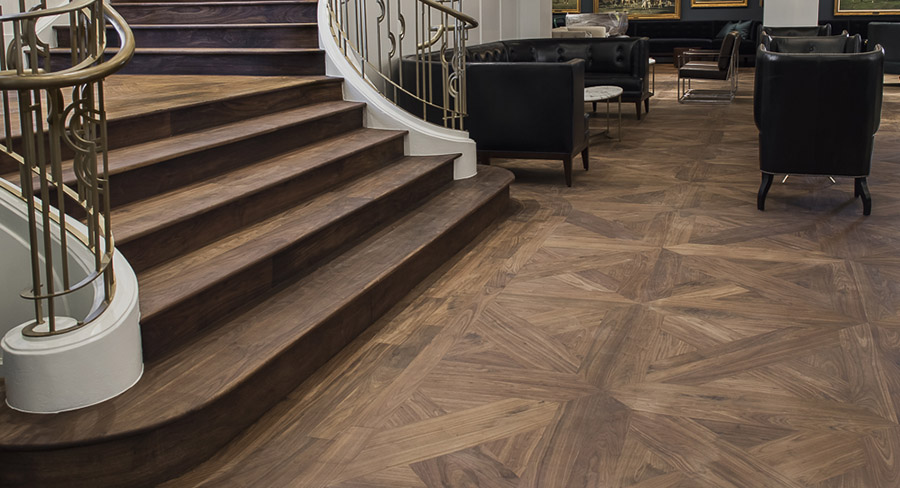
Hardwax oil may be used for beautifying and protecting a variety of wood surfaces across residential, commercial and industrial applications. These include wood flooring, stairs and millwork like baseboards, among others. Additionally, hardwax oil is well-suited for surfaces like cork, wood fibre panels and engineered wood products.
In high-traffic commercial spaces, such as hotels, restaurants and retail stores, hardwax oil provides a durable and repairable finish that withstands wear while maintaining a natural aesthetic. In residential applications, it enhances the warmth and character of wood surfaces while allowing for easy maintenance. Hardwax oil is also commonly used in historic building restoration, where maintaining the authenticity of original wood surfaces is a priority.
Hardwax oil is formulated for both interior and exterior applications, making it a versatile choice for a wide range of woodworking and architectural projects.
As marketing director of Rubio Monocoat Canada, Keith Hardisty leads the promotion of innovative, plant-based hardwax oil wood finishes. Rubio Monocoat’s unique molecular bonding technology allows for a one-coat application that is easy to use, highly durable, volatile organic compound-free and enhances the natural beauty of wood. Keith can be reached at [email protected].